Patient mood data in session: a practical guide
Concrete in-session patterns, common concerns addressed directly, and a depth-oriented frame for the chart as a third object in the room.
A patient shows you their phone at the start of session. They have been tracking their mood for three weeks, every day, sometimes twice. They pull up a graph. Wednesday is a spike. Friday is a trough. There is a small note attached to Saturday that says only "fight." They want to know what you think the pattern means.
What you do in the next thirty seconds matters more than the data does.
This is a piece for clinicians who are encountering more and more patient-provided data in the room, who have not entirely decided what to do with it, and who would like a framework that does not require deciding in advance whether the entire category of consumer mental health apps is a good idea. The honest answer to that larger question is "it depends," and most of what follows is an attempt to articulate what it depends on.
I write as a fellow clinician (LMFT, doctoral training in clinical psychology, practice oriented to depth and personality-organization work) and as the maker of one of the apps in this category. I have tried to be honest about both vantage points throughout.
What the literature actually supports
Measurement-based care, the practice of administering brief validated instruments at regular intervals and using the results to inform treatment direction, has a credible if modest evidence base. The largest meta-analyses, including the often-cited work on routine outcome monitoring in psychotherapy, suggest small-to-moderate improvements in outcomes when feedback is used systematically and somewhat larger improvements specifically for patients who are not on track. The effect sizes are not transformative. They are real.
Importantly, this evidence is for brief validated instruments administered with structured feedback to the clinician (PHQ-9, GAD-7, PROMIS, OQ-45, ORS/SRS, similar). It is not the same evidence base as "consumer mood tracking app used between sessions." The two often get conflated in the discourse, and they should not.
What this means in practice. When a patient brings a tracked PHQ-9 score with them, you have something that the literature recognizes. When they bring a screen of emoji ratings with optional habit checkboxes, you have something the literature is mostly silent about. Both can be useful. They are useful in different ways.
The four concerns clinicians raise, addressed honestly
Most clinical objections to patient-tracked data cluster into four buckets. I want to take each seriously rather than dismiss them.
"Will it harm the alliance?"
The empirical answer is mixed and depends heavily on stance. There is some evidence that feedback-informed treatment, when the feedback is shared openly with the patient, can strengthen the alliance by signaling collaborative attention to outcomes. There is anecdotal and clinical evidence that data introduced in the wrong way (as a verdict, as a corrective, as evidence in an argument) can rupture it.
The practical move is to treat the data as material the two of you are looking at together, not as material you are evaluating the patient with. The difference is audible in the room. "I see your scores dropped this week" sounds like a performance review. "What was it like for you to see your scores drop this week?" sounds like a session.
"Will it foster checking behavior?"
This is a real risk, particularly for patients with OCD, generalized anxiety, or trauma-related hypervigilance. Tracking can become a compulsive ritual that increases anxiety rather than serving as a window into it. Three protective patterns:
- Time-limit the tracking window when introducing it. "Let us track for the next four weeks and see what we see" is a different posture than "track indefinitely so we have data."
- Make the in-session use of the data observational rather than evaluative. When tracking is in service of looking together, it is harder to mobilize as a checking ritual. When it is in service of producing a number that something rides on, the ritual quality intensifies.
- Notice the tracking itself as clinical material. Frequency, intensity, missed days, the patient's affect when they discuss their own data. These are diagnostically rich in their own right.
For some patients you will conclude, after a few weeks, that tracking is making things worse and you will recommend pausing it. This is a reasonable clinical move and the patient will respect it more than they would respect the absence of clinical opinion.
"Will it replace the work?"
The work is the relational, depth, behavioral, or integrative process that has always been the work. Data does not replace it. Data can crowd it, if you let it.
The phenomenon to watch for is the patient who arrives with a chart and wants to spend the session interpreting the chart. This is sometimes useful and sometimes a defense, in the strict technical sense of the word. A patient who has had a hard week may find it considerably less threatening to discuss a graph of their hard week than to be in the hard week with you. The chart can become a screen behind which the actual material hides.
The countermove is gentle and consistent. Look at the chart briefly, name what is interesting, then return the session to the patient. "These look like rough days. Walk me through Wednesday." The chart provided the entry point. The session is what happens next.
"Is the data reliable enough to use clinically?"
Patient-tracked mood data is self-report. It is subject to recall bias, mood-state-dependent recall, social desirability, demand characteristics, and the simple fact that the patient may have edited the entry an hour before session. None of this is news.
The right calibration is not "the data tells me what is true." It is "the data gives me a starting condition for a conversation that might tell me something." The reliability of the conversation is what matters. The reliability of the data is what makes the conversation more concrete than it would otherwise be.
For high-stakes decisions (medication changes, hospitalization, level-of-care escalation), patient-tracked data is supplementary at best. The clinical interview remains primary. A graph showing improvement is not sufficient evidence to step down level of care if the interview suggests otherwise.
Three practical patterns for using tracked data in session
These are patterns I use in my own practice. They are not the only patterns. They are concrete enough to try.
The thirty-second look
At the start of session, the patient pulls up their tracker. You look at it together for thirty seconds. You name one thing that catches your eye. The patient names one thing that catches theirs. The phone goes away.
The point is not to analyze the data. The point is to let the data nominate a topic. Whatever the two of you flagged in those thirty seconds is almost always more useful than wherever the conversation would have organically drifted, because the data has already done some of the noticing for you.
This is the lightest possible use, and it works across orientations.
The pattern check
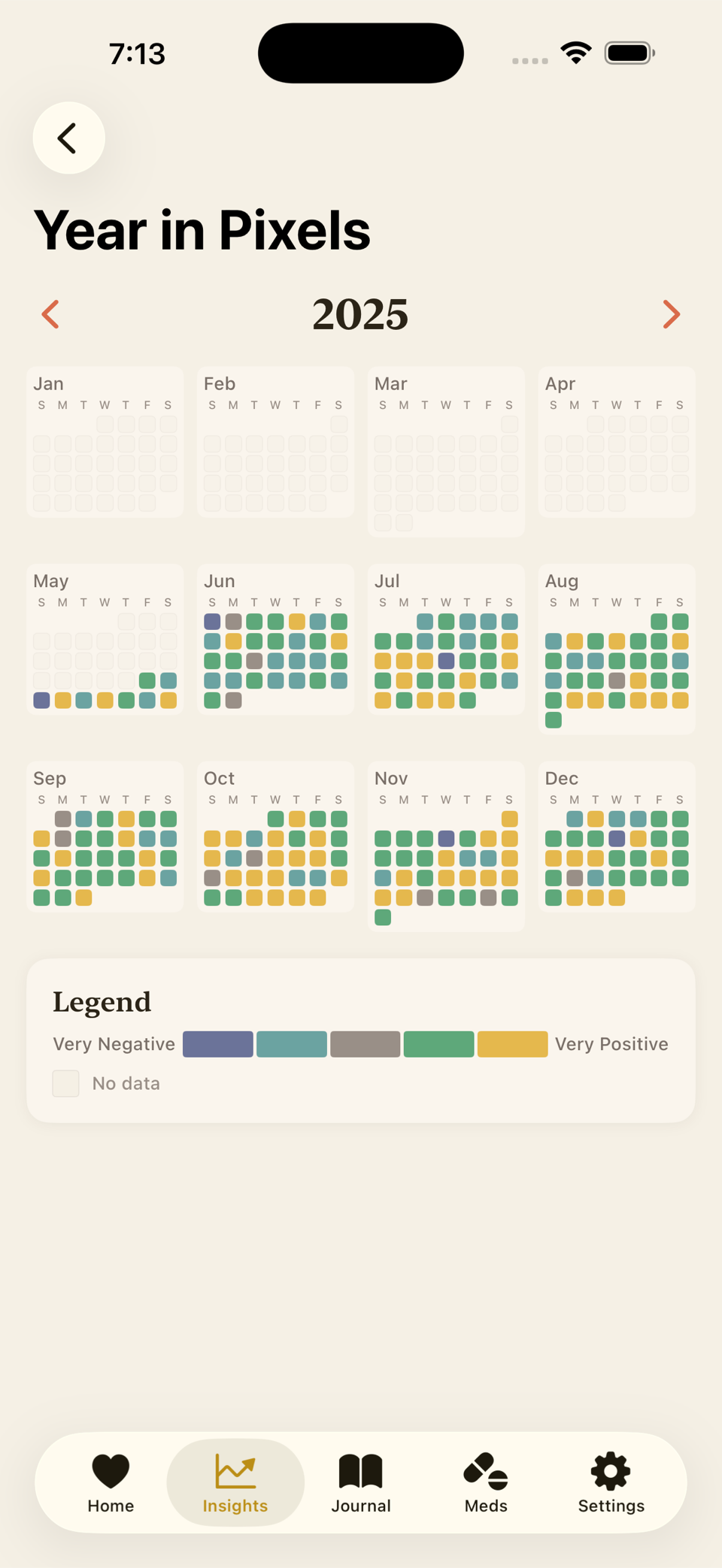
Roughly monthly, you and the patient look at a longer view together. Not single days. Trends across weeks. What is moving. What is stable. What is conspicuously absent (a flat line during a week that ostensibly contained a major event is itself information).
This is a measurement-based-care use of data. You are checking whether the treatment direction is producing the kind of change you and the patient hoped for. It can usefully accompany other ongoing assessment instruments. It can prompt a conversation about whether the approach is working and whether to recalibrate.
Do not do this every session. Once a month is enough. More often turns it into a referendum.
The discrepancy moment
The most clinically rich use of tracked data is when it diverges from the patient's stated experience. They report a good week. The chart shows three significant dips. They report a terrible week. The chart shows mostly steady moderate days.
The right move here is curiosity, not correction. "I want to understand the gap between what you are telling me and what you wrote down." Either source could be the more accurate one. The discrepancy itself is the material. This is where some of my best sessions have come from, with patients who are surprised by their own data and then surprised by their own surprise.
A depth-oriented frame
For clinicians working in psychodynamic, MBT, TFP, or other depth-oriented frames, the standard measurement-based-care literature can feel reductive. The patient is not a set of weekly PHQ-9 scores. The work is not optimization. The room is not a dashboard.
This is correct, and it does not foreclose the use of tracked data. A few reframes.
The chart is not a substitute for the relationship. It is a third object in the room. Like a dream, like a transference enactment, like a piece of artwork the patient brings in, it is something the two of you can look at together.
The looking is shared and is itself relational. The data is the occasion, not the content.
Tracking can be a defense. Compulsive tracking, in particular, frequently functions as a way to manage feelings rather than experience them. Externalize the affect to a number; track the number; intervene on the number. The patient never has to be in the feeling. This is worth naming when you see it, in the same way you would name any other ego-syntonic defense that the patient is mobilizing in session.
Tracking can also be a useful externalization. For patients whose interoceptive awareness is limited (alexithymia, post-traumatic flatness, certain personality structures), a daily mood entry is a small structured invitation to register what is happening internally. It is a developmental scaffold. Some patients lose the scaffold organically over time as they learn to do the noticing without it. Some retain it. Both are reasonable.
Defense-mechanism logging, where the app supports it, is interesting. It is more clinically loaded than mood logging. Patients who track their own defenses are doing a piece of the work that traditionally happens only in session. This can accelerate the work. It can also produce facile labeling. Worth discussing in the room when the patient brings up specific entries.
The general principle: nothing about tracked data is incompatible with depth-oriented practice, provided the clinician retains the frame that the data is material, not verdict. The data points toward something. What it points toward becomes intelligible in the room.
Special cases
A few populations where the default guidance shifts.
Children and adolescents
For children under about 12, the cognitive prerequisites for accurate self-report are present but limited, and the developmental valence of being asked to track yourself daily is different than it is for adults. The general guidance: keep tracking light, prefer apps designed for the relevant developmental stage (age-tier vocabulary, age-appropriate visual design, no clinical jargon), and watch for the patient's parent treating the data as a surveillance tool. The last item is the most common failure mode.
For adolescents 13 and up, tracking is generally usable with adult-style attention, with one specific caveat: confidentiality around the data is non-trivial. If the patient is using a tracker on a shared family iCloud account, their parent can potentially see entries. Discuss this explicitly before recommending any tool.
High-acuity patients
For patients with active suicidality, recent self-harm, dissociation under stress, or psychotic features, the question is whether tracking adds clinical signal or adds load. Sometimes it does the first. Sometimes it does the second. Default to less tracking, not more, when in doubt. Safety check-ins inside an app are not a substitute for safety planning with you.
Patients with OCD or generalized anxiety
Already discussed above. The brief version: time-limit the tracking, monitor for compulsive use, and be prepared to pause it. Some patients in this group will tell you, unprompted, that the tracking has become a source of anxiety. Believe them.
Couples and families
The single-user model used by most modern privacy-conscious mood apps is a structural reason to recommend them: there is no shared-account temptation to look at a partner's entries. For couples or family work, this is a feature, not a limitation.
What I look for in an app before I recommend one
A clinician-facing checklist, briefer than the consumer one. These are the questions I ask before I would suggest a specific tracker to a patient.
- Is the data on-device, with no third-party analytics or tracking SDKs? This is the privacy bar I set for any mental health app I recommend. Server-side storage and the ad-tech industry are not compatible.
- Does the app include validated screeners (PHQ-9, GAD-7, WHO-5, similar) presented with appropriate disclaimers? Self-administered screeners are useful when the tool treats them as screeners rather than as diagnostic instruments. The disclaimer matters.
- Does the app handle safety appropriately? Suicide-screening items, crisis resources accessible without paywall, escalation pathways that match standard care. This is a non-negotiable bar.
- Does the app produce something I can actually look at in session? A graph, a summary, a PDF export. Some clinical workflow integration is helpful even when the app does not formally integrate with EHRs.
- Is the developer accountable in a meaningful way? Real name, real credentials, real address, real contact. The mental health app graveyard is full of well-meaning projects that got acquired or abandoned and changed their privacy posture as a result.
The Observing Ego is the app I built, and it meets these criteria by design. I am not in a position to be neutral about it. Other apps in the category also meet these criteria, more or less, and they are reasonable to recommend depending on the specific patient. The bar is what matters; which specific tool meets the bar is a smaller question.
A practical session-by-session workflow
If you would like to try patient-tracked mood data in your practice without overhauling your approach, here is a minimal workflow.
- Session 1 of the experiment. Discuss the idea with the patient. If they are interested, agree on a four-week trial. Pick the app together; do not assign it.
- Session 2 through 5. Use Pattern 1 (the thirty-second look) at the start of each session. Do not let it expand to consume the session. Notice the patient's affect when they share the data, both early in and across the trial.
- End of session 5 (week four). Use Pattern 2 (the pattern check). Look at the longer view together. Ask the patient what they have learned about themselves, if anything.
- End of session 5, second half. Decide together whether to continue tracking, pause it, or shift to a different cadence. Both of you should genuinely have a vote.
Four weeks is enough time to see whether the tool is useful for this patient. It is short enough to abandon without sunk-cost dynamics if it is not.
Closing
The data is not the work. The work is the relationship between you and the person sitting across from you, the work that has been the work for over a century and that will continue to be the work for as long as the field exists. Tracked mood data is one of many possible aids to that work, with specific advantages and specific risks. The advantages are larger when the clinician retains the frame that data is material, not verdict, and when the patient retains the experience that the relationship is the point.
For the right patient, used the right way, an app of this kind can deepen the work. For the wrong patient, used the wrong way, it can flatten it. The difference is almost entirely in what you do with it in the room.